
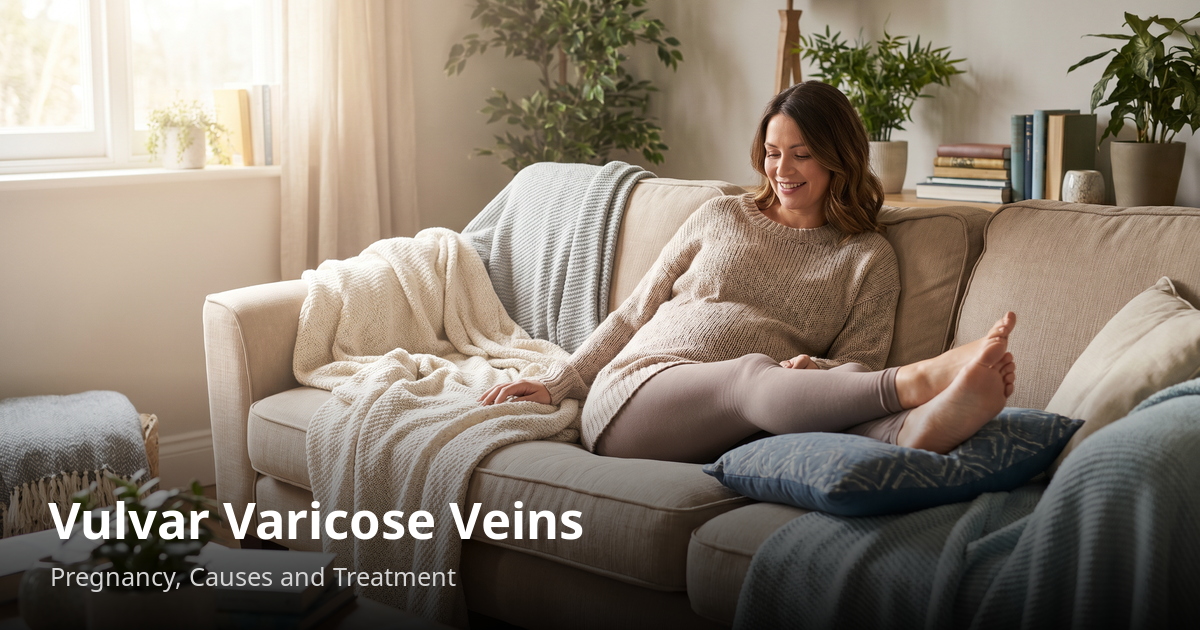
Vulvar Varicose Veins: Causes, Pregnancy, and Treatment
Endovascular Surgeon & Interventional Radiologist — trained at Mount Sinai & Columbia University / NYP, New York. Founder of Israel Vein Center; Senior Attending, Shamir Medical Center.
Vulvar varicosities — enlarged veins of the vulva and labia — affect up to 1 in 10 pregnant women, usually from the second pregnancy on. They are rarely discussed, often alarming to discover, and very treatable. Here is what actually matters.
Why they happen
Pregnancy raises blood volume while hormones relax vein walls, and the growing uterus presses on the pelvic veins that drain the vulva. The result is pooling and bulging veins — frequently alongside leg varicose veins in pregnancy. Outside pregnancy, vulvar veins usually signal reflux higher up, in the pelvic (ovarian) veins — the female counterpart of the male varicocele.
Symptoms
Visible soft bulges, a dragging heaviness or pressure that builds through the day and eases lying down, ache after long standing, and sometimes discomfort during intimacy. Symptoms typically worsen as pregnancy advances.
During pregnancy: manage, don’t treat
Definitive treatment waits until after delivery. Meanwhile: support garments designed for vulvar veins, leg elevation, cool compresses for ache, avoiding very long standing, and light activity — movement helps venous return. Most vulvar varicosities regress substantially within about three months postpartum.
After pregnancy: when and how to treat
Veins that persist three months after delivery deserve evaluation with a venous duplex ultrasound. Isolated vulvar veins are treated with sclerotherapy — brief clinic sessions, no anesthesia. When imaging shows a pelvic source, ovarian vein embolization closes the refluxing vein through a tiny catheter — an endovascular procedure Dr. Aronhime performs, with same-day discharge.
Frequently Asked Questions
Are vulvar varicose veins dangerous?
Usually not. They can ache and feel heavy, but serious complications are rare. A superficial clot (thrombophlebitis) causes a painful firm lump and deserves prompt review; significant bleeding is very uncommon. Persistent veins after delivery are mainly a comfort and circulation issue, not a danger.
Will vulvar veins go away after the birth?
Most regress substantially within 6 weeks to 3 months after delivery, as hormones and pelvic blood volume normalize. Veins that persist beyond that usually have an underlying pelvic venous source and can be treated.
Can I still have a vaginal delivery?
In almost all cases, yes. Vulvar varicosities are not by themselves a contraindication to vaginal birth — the veins are soft and compressible. Mention them to your obstetric team so they are documented.
How are persistent vulvar veins treated?
Isolated vulvar veins respond well to sclerotherapy at the clinic. When a duplex study points to reflux from the pelvis (ovarian vein insufficiency), catheter-based embolization closes the faulty vein from within — no incisions, local anesthesia, home the same day.
Ready to Book a Consultation?
Duplex ultrasound mapping included at the first visit
Israel Vein Center — Lilienblum 17, Tel Aviv
 Dr Shimon Aronhime MD/varicose-vein-treatment-summer-israel-768x403.png)
 Dr Shimon Aronhime MD/insurance-varicose-vein-israel-768x403.png)