Dr Shimon Aronhime MD/varicocele-treatment-israel.png)
Varicocele Treatment in Israel — Embolization vs Surgery
Endovascular Surgeon & Interventional Radiologist — trained at Mount Sinai and Columbia/NYP, New York. Founder of the Israel Vein Center and senior physician at Shamir Medical Center.
What Is Varicocele?
Varicocele is the abnormal dilation of the network of veins surrounding the testis — the pampiniform venous plexus. Think of it as varicose veins of the scrotum: vessels that have lost their ability to drain efficiently, allowing blood to pool and heat to accumulate. It is found in about 15% of men and in roughly 35–40% of men evaluated for infertility. Most men who have one have no symptoms, and most varicoceles never need treatment.
Why Is It Usually on the Left — and When Is a Right-Sided One Checked?
A varicocele forms when the valves in the testicular vein stop closing, so blood flows backward and pools around the testicle. The left side is affected far more often: the left testicular vein joins the left kidney (renal) vein at a right angle, which raises the pressure inside it, while the right one drains at a gentler angle into the inferior vena cava. Still, some studies find varicoceles on both sides in up to half of the men who have one.
Three situations call for a prompt check, sometimes with abdominal imaging: a varicocele on the right side only, which is uncommon; one that appears suddenly, especially later in life; and one that doesn’t empty when you lie down. Occasionally the problem starts higher up, where the left kidney vein is squeezed: nutcracker syndrome.
Symptoms to Watch For
- Dull scrotal ache or heaviness — typically on the left, worse after prolonged standing or heat exposure
- Palpable or visible dilated veins — the classic “bag of worms” sensation
- Testicular atrophy — the affected testis may be noticeably smaller
- Abnormal semen analysis — low count, poor motility, or abnormal morphology
- Incidental finding — on scrotal ultrasound performed for another reason
Sudden, severe testicular pain is not typical of a varicocele. It can be testicular torsion, an emergency: go straight to the ER.
How Is It Diagnosed and Graded?
The doctor examines you standing and lying down, sometimes while you bear down (the Valsalva maneuver), which fills the veins. On examination, grade 1 can be felt only while bearing down, grade 2 can be felt while standing without bearing down, and grade 3 is visible through the skin; a varicocele seen only on ultrasound is called subclinical.
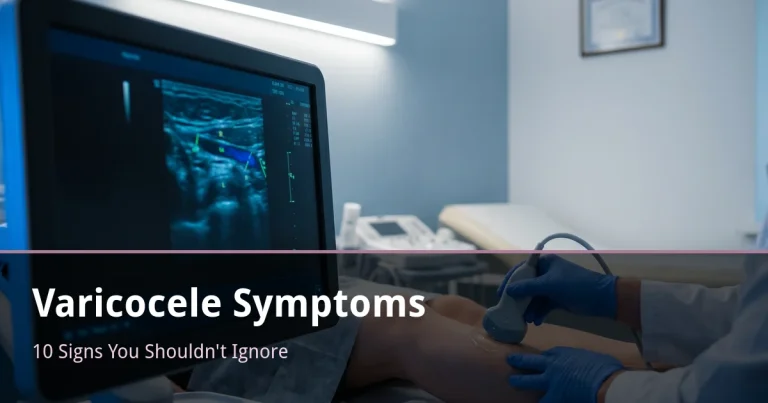
A scrotal duplex ultrasound confirms the diagnosis and shows the backward flow. At our Tel Aviv clinic, Dr. Aronhime, a native English speaker, performs it himself during the consultation. Ultrasound reports may use a different scale, but either way, varicocele grades describe the vein; they don’t decide treatment on their own.
Does a Varicocele Affect Fertility and Testosterone?
It can, but many men with a varicocele have a normal semen analysis and are fertile. Pooled blood warms the testicle, which works best a little below body temperature; this is thought to be the main way a varicocele can impair sperm production over time. For couples having difficulty conceiving:
- When repair makes sense: the American AUA/ASRM guideline recommends considering it when the man has a varicocele that can be felt on examination and an abnormal semen analysis, and the couple is infertile (men with no sperm at all are a separate case). It advises against repair for fertility when the varicocele was seen only on ultrasound.
- What to expect: in the Cochrane review, couples were about 1.5 times as likely to conceive after treatment as with no or delayed treatment (low-certainty evidence); whether treatment leads to more live births is uncertain.
A varicocele may also lower testosterone in some men; more in varicocele, testosterone and fertility.
When Should a Varicocele Be Treated?
Most varicoceles need no treatment. It’s worth discussing when there is:
- Difficulty conceiving, with a varicocele that can be felt and an abnormal semen analysis.
- Persistent pain that affects daily life, once other causes have been ruled out.
- A teenager’s testicle falling behind: on repeat measurements, the testicle on the varicocele side stays clearly smaller. See our guide to varicocele in teenagers.
- Low testosterone, in selected men with a significant varicocele.
The grade alone doesn’t decide: even a grade 2–3 varicocele with no pain and a normal semen analysis can usually just be monitored.
Embolization or Surgery: How Do They Compare?
There are two main ways to close the leaking vein: microsurgery, performed by a urologist, or embolization, performed through a catheter.
| Microsurgery | Embolization | |
|---|---|---|
| Who performs it | A urologist | Dr. Aronhime, at Shamir Medical Center |
| How the vein is reached | A small incision in the groin | A needle puncture in a groin or neck vein; no incision |
| Anesthesia | As decided by the surgeon | Local, sometimes with light sedation |
| Back to routine | As instructed by the surgeon | Usually within 24–48 hours; no heavy lifting or contact sports for 5–7 days |
| Recurrence (pooled studies, 1980–2008) | About 1% | About 12.7% |
| Hydrocele (fluid around the testicle) | About 0.4% (same studies) | Uncommon: about one-fifth the odds of surgical ligation (2025 meta-analysis) |
A 2025 meta-analysis of 30 studies drew a similar picture: the varicocele came back somewhat more often after embolization than after high surgical ligation, but embolization had fewer complications overall and much less hydrocele.
For fertility, neither surgery nor embolization has been shown to be clearly better: in the Cochrane review, the evidence from trials comparing the two was too uncertain to tell. In the older, non-randomized studies, natural pregnancy rates were higher after microsurgery, and some urologists prefer surgery when fertility is the reason for treatment. So when pregnancy is the goal, make the decision together with a urologist or fertility doctor.
Embolization succeeds in about 9 of 10 attempts, less often on the right side; if the catheter can’t reach the vein, surgery remains an option. When both sides need treatment, they are usually closed in the same session; the right vein is sometimes harder to reach, or is treated separately. Beyond that, the choice depends on your anatomy, any previous surgery, the reason for treatment and your preference.
How Is Varicocele Embolization Done?
Embolization seals the leaking testicular vein from the inside. Dr. Aronhime, an endovascular surgeon, performs it at Shamir Medical Center (Assaf Harofeh); when medically indicated, it is usually funded by your kupat holim through a Tofes 17.
- Local anesthesia, sometimes with light sedation
- A needle puncture into a vein in the groin or neck
- A thin catheter is guided under X-ray to the testicular vein
- Venography (an X-ray dye study) maps the leak and any side branches
- The vein is closed with tiny metal coils and/or sclerosant foam
- The catheter is removed; no stitches are needed
X-ray exposure is kept as low as possible, and you go home after a few hours of observation.
What Happens After Treatment?
This is what life after embolization usually looks like:
- First 24–48 hours: most men return to routine activities and desk work.
- First week: no heavy lifting or contact sports for 5–7 days. A dull ache is common for a few days, occasionally up to about 10; simple painkillers are usually enough.
- Compression stockings: not needed; this isn’t a leg procedure.
- Follow-up: a Doppler ultrasound at about 3 months checks that the backward flow has stopped (veins you can still feel aren’t necessarily a failure), and if fertility was the reason for treatment, a semen analysis follows at about 4–6 months.
Fever, pain that gets worse instead of better, or a growing swelling at the puncture site needs prompt medical attention: call your doctor, or go to the ER if needed.
For a consultation: Contact us | +972-73-374-4040
Frequently Asked Questions
What is varicocele and who gets it?
Varicocele is the dilation of the pampiniform venous plexus surrounding the testis — essentially varicose veins of the scrotum. It is found in about 15% of men and in roughly 35–40% of men evaluated for infertility. It is far more common on the left side, because of the angle at which the left testicular vein drains into the left renal vein, though many men have one on both sides.
How does varicocele cause infertility?
The main explanation is heat: blood pooling in the enlarged veins warms the testicle, which works best a little below body temperature, and over time this can lower sperm count, motility and quality. Many men with a varicocele are still fertile. For couples having difficulty conceiving, the Cochrane review found that treatment may improve pregnancy rates (low-certainty evidence); its effect on live births is uncertain.
What is varicocele embolization and how does it differ from surgery?
Embolization closes the leaking testicular vein from the inside. Under local anesthesia, sometimes with light sedation, a thin catheter is passed through a neck or groin vein to the testicular vein, which is then blocked with coils and/or sclerosant foam. There is no incision, and most men return to routine activities within 24–48 hours. Compared with surgical ligation it has fewer complications and much less hydrocele, but the varicocele recurs more often, especially compared with microsurgery.
Is varicocele embolization painful?
Usually there is little pain: it’s done under local anesthesia, sometimes with light sedation. Afterwards, a dull ache in the scrotum or at the puncture site is common for a few days, occasionally up to about 10, and simple painkillers usually control it. Most men are back at desk work within a day or two and resume strenuous activity after about a week.
Do Israeli health funds cover varicocele embolization?
With a documented medical indication — persistent pain, impaired semen parameters, or a testicular volume gap — there is usually a public funding pathway for hospital-based treatment via a Tofes 17 (Form 17) commitment, sometimes supplemented by the complementary insurance tiers. Eligibility is verified individually during consultation. Consultation fees are listed on our pricing page.
Who treats a varicocele — a urologist or an endovascular surgeon?
Both, depending on the route. A urologist handles the fertility workup and surgical repair, such as microsurgery; endovascular surgeons and interventional radiologists perform catheter embolization. When fertility is the goal, your urologist or fertility doctor stays involved either way. At our Tel Aviv clinic, Dr. Aronhime examines you, performs the duplex ultrasound and explains whether monitoring, embolization or a referral for surgery fits best.
Should a varicocele be treated before IVF or ICSI?
Not automatically; decide with your fertility doctor. A meta-analysis of four retrospective studies (870 ICSI cycles) found higher pregnancy and live-birth rates when a palpable varicocele was surgically repaired before ICSI than when it wasn’t. The studies weren’t randomized, and semen improvement takes a few months to show, so the partner’s age and the time available matter.
My varicocele came back after surgery — can it be embolized?
Often, yes; embolization suits this well. Venography shows which vein or side branch is feeding the recurrence, and it is closed from the inside without operating again through scar tissue. In reported series of recurrence after surgery, embolization was technically successful in about 93–100% of cases. A Doppler ultrasound first confirms that the varicocele has really come back.
Scientific References
- Alsaikhan B, et al. Epidemiology of varicocele. Asian J Androl, 2016. PMID: 26763551
- Esteves SC, et al. Outcome of assisted reproductive technology in men with treated and untreated varicocele: systematic review and meta-analysis. Asian J Androl, 2016. PMID: 26510504
- Schlegel PN, et al. Diagnosis and treatment of infertility in men: AUA/ASRM guideline part II. Fertil Steril, 2021. PMID: 33309061
- Persad E, et al. Surgical or radiological treatment for varicoceles in subfertile men. Cochrane Database Syst Rev, 2021. PMID: 33890288
- Cayan S, et al. Treatment of palpable varicocele in infertile men: a meta-analysis to define the best technique. J Androl, 2009. PMID: 18772487
- Halpern J, et al. Percutaneous embolization of varicocele: technique, indications, relative contraindications, and complications. Asian J Androl, 2016. PMID: 26658060
- Chen H, et al. Comparison of sclero-embolization and surgical ligation for varicocele treatment: a systematic review and meta-analysis. World J Urol, 2025. PMID: 41137990
Dr. Shimon Aronhime — Endovascular Surgeon
Clinic: 17 Lilienblum St, Tel Aviv | +972-73-374-4040
Book a consultation | WhatsApp
Ready to Book a Consultation?
Duplex ultrasound mapping included at the first visit
Israel Vein Center — Lilienblum 17, Tel Aviv