
 Dr Shimon Aronhime MD/varicocele-treatment-israel.png)
Varicocele Treatment in Israel — Embolization vs Surgery
Endovascular Surgeon & Interventional Radiologist — trained at Mount Sinai & Columbia University / NYP, New York. Founder of Israel Vein Center; Senior Attending, Shamir Medical Center.
What Is Varicocele?
Varicocele is the abnormal dilation of the network of veins surrounding the testis — the pampiniform venous plexus. Think of it as varicose veins of the scrotum: vessels that have lost their ability to drain efficiently, allowing blood to pool and heat to accumulate. It affects approximately 15% of all men and is found in up to 35% of men evaluated for infertility.
The left side is far more commonly affected. Anatomically, the left testicular vein drains at a perpendicular angle into the left renal vein, creating a higher hydrostatic pressure column compared to the right side, which drains directly into the inferior vena cava at an oblique angle.
Symptoms to Watch For
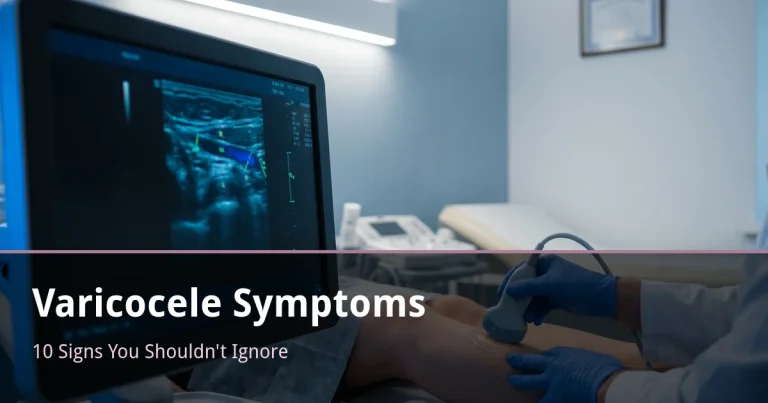
- Dull scrotal ache or heaviness — typically on the left, worse after prolonged standing or heat exposure
- Palpable or visible dilated veins — the classic “bag of worms” sensation
- Testicular atrophy — the affected testis may be noticeably smaller due to impaired testosterone production
- Abnormal semen analysis — low count, poor motility, or abnormal morphology
- Incidental finding — on scrotal ultrasound performed for another reason
Varicocele and Infertility
The mechanism is primarily thermal. Pooled venous blood raises intrascrotal temperature above the narrow optimal range for spermatogenesis (~34–35°C). Even a half-degree elevation chronically impairs sperm production. Studies consistently show that treating varicocele improves sperm parameters in 60–70% of men, with corresponding improvements in natural pregnancy rates and IVF outcomes.
Embolization: The Interventional Radiology Approach
Dr. Aronhime performs varicocele embolization — a procedure developed and refined by interventional radiologists. The technique:
- Local anesthesia at the neck (jugular approach) or groin (femoral approach)
- A 3–4 Fr catheter is advanced under fluoroscopic guidance to the internal spermatic vein
- Venography confirms position and identifies any collateral branches
- The vein is blocked internally using metallic coils and/or foam sclerosant
- Catheter removed — no sutures required
Procedure time: 30–45 minutes. Discharge: same day. Return to work: next day. Return to strenuous activity: 5–7 days.
Embolization vs Surgery: How Do They Compare?
Surgical varicocelectomy (Palomo or microsurgical inguinal/subinguinal) requires general or spinal anesthesia, a skin incision, and 1–2 weeks recovery. Success rates (improvement in semen parameters, pregnancy rates) are equivalent between the two approaches. Embolization offers: no general anesthesia, no incision, shorter recovery, and the ability to treat bilateral varicocele through a single access point.
Who Is a Candidate?
Evaluation is appropriate for men with: chronic scrotal pain, abnormal semen analysis before IVF/IUI cycles, testicular atrophy on the affected side, or grade 2–3 varicocele on clinical examination. Dr. Aronhime performs a scrotal duplex Doppler as part of the consultation to confirm the diagnosis and plan the procedure.
For a consultation: Contact us | +972-73-374-4040
Frequently Asked Questions
What is varicocele and who gets it?
Varicocele is the dilation of the pampiniform venous plexus surrounding the testis — essentially varicose veins of the scrotum. It affects about 15% of all men and 35% of men evaluated for infertility. It is far more common on the left side due to the anatomical angle at which the left testicular vein drains into the left renal vein.
How does varicocele cause infertility?
Pooled venous blood elevates scrotal temperature above the optimal range for spermatogenesis. This impairs Sertoli cell function (which nurture developing sperm) and Leydig cell testosterone production. The result: reduced sperm count, motility, and morphology. Embolization improves sperm parameters in approximately 60–70% of treated men.
What is varicocele embolization and how does it differ from surgery?
Embolization is an image-guided, minimally invasive procedure performed under local anesthesia. A thin catheter is advanced through a neck or groin vein to the internal spermatic vein, which is then blocked internally with coils or sclerosant foam. No incision, no general anesthesia, and return to normal activity within 24–48 hours. Success rates are equivalent to surgical ligation, with fewer complications.
Is varicocele embolization painful?
The procedure itself is performed under local anesthesia and is not painful. Some men experience a dull ache or scrotal heaviness for 1–3 days afterward, easily managed with over-the-counter analgesia. Most men return to desk work the following day and resume physical activity within a week.
References
- American Urological Association / ASRM guidance on varicocele: repair improves semen parameters in appropriately selected men with infertility.
Ready to Book a Consultation?
Duplex ultrasound mapping included at the first visit
Israel Vein Center — Lilienblum 17, Tel Aviv
 Dr Shimon Aronhime MD/venous-doppler-ultrasound-israel-768x403.png)
 Dr Shimon Aronhime MD/varicose-veins-after-pregnancy-israel-768x403.png)